


Not Every Problem is a Disaster: Helping Students Rethink Story Conflict
Updated: Sep 4, 2025

When it was time to teach story structure, I’d start by walking students through the parts of a plot—the exposition, problem, rising action, climax, falling action, and solution—and then work to identify those elements in a book we previously read aloud.
What I came to discover, however, was that many students were having a hard time identifying the problem in the stories we read—something I always believed would be easier to identify. When we read Owl Moon, for instance, many students stared at me blankly when I asked what the problem was. I also got a few “There isn’t one” responses.
That got me thinking. And that’s when I wondered...
What if the reason my students can’t identify the problem in a story… is because they don’t know what a “problem” really is?
Here’s what I realized...
When kids hear the word “problem,” they often think of something truly bad—something wrong, dangerous, dramatic, or upsetting. And while that is sometimes true, it’s definitely not always true. In many stories, the problem is much more subtle than that:
👉 A character might wants something he or she does not have
👉 A character might lack confidence or an ability
👉 A character might be struggling with laws or beliefs in a community
The rest of the story unfolds because of that internal desire or obstacle. A problem doesn't necessarily have to be big or loud to be a problem.
That's when I realized I needed to shift how I teach conflict and help kids rethink what conflict really is.
How I Shifted My Teaching (and Why It Worked)
Instead of trying to teach story structure all at once—or tackling both problem and solution in a single lesson—I began dedicating an entire reading lesson (and sometimes even more) just to the problem. Slowing down and diving deep into conflict is what truly made the difference in student understanding and engagement.
Here are a few of the slides I created & used to explicitly teach problem/conflict:

After explicitly teaching what a problem is, I'd move on to teaching the different types of conflict. Now, I am not asking my students to memorize the specific types of problems like character vs. nature or character vs. society,
What I am doing is planting the seed that not all problems look the same.
When we introduce different types of conflict, kids begin to realize that a problem can be so many different things:
👉 A problem can be internal (a character unsure what to do)
👉 A problem can be external (a storm, a bully, a strict rule)
👉 A problem can be quiet (a longing, a fear, a hope)

Using Movie Clips to Teach Different Types of Conflict
One of the most successful—and fun—ways I teach the different types of conflict is by using short video clips from popular movies. I actually came across this idea on Mary Montero’s blog, Teaching with a Mountain View, and decided to try it in my own classroom. It turned out to be a big hit with my students and was a great way to introduce the different types of conflict.
Applying Conflict Types to Books
Once students were introduced to the types of conflicts using video clips, we brought that understanding back to the books we read. For example, in The Good Egg by Pete Oswald, we identified the type of conflict the main character faced (character vs. self) and then used that to help us pinpoint the real problem in the story.
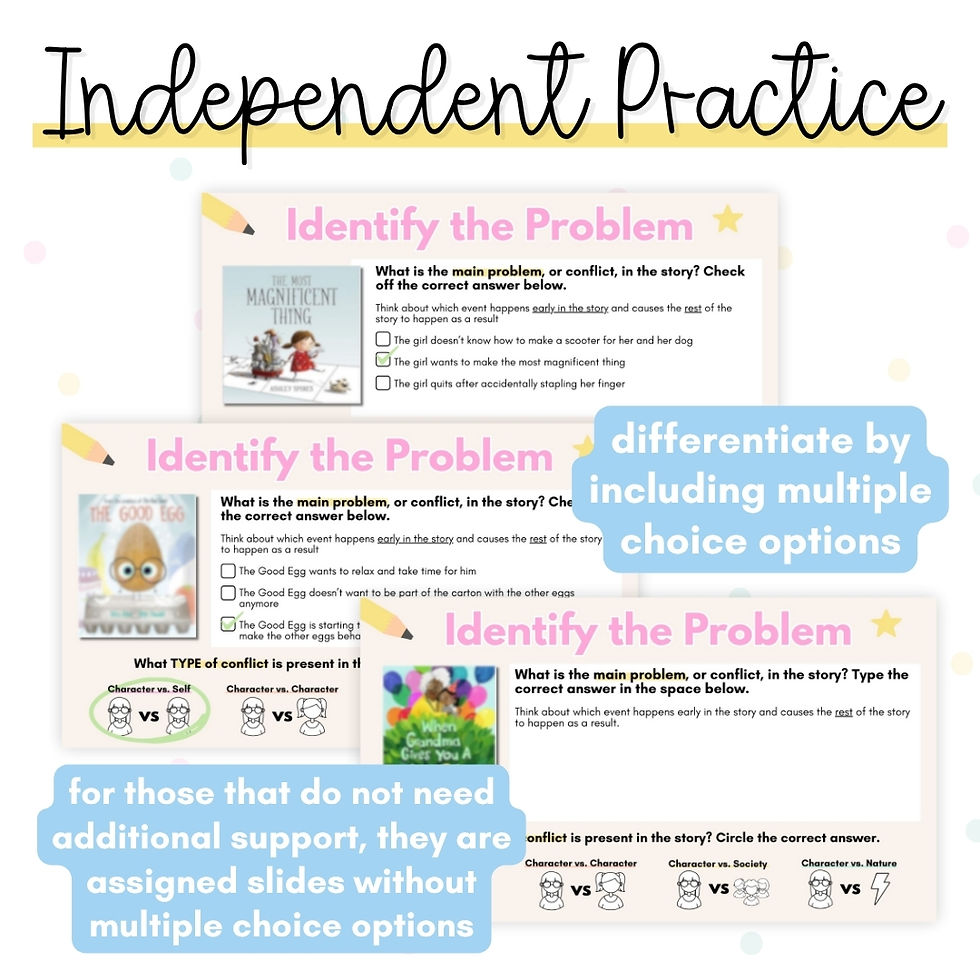
The shift in how I approached and taught conflict truly made a difference- it actually helped students correctly identify the problem in a story with increasing independence.
If your students are struggling to identify the conflict in a fiction story, they may be holding onto a common misconception about what a story’s problem really is. A simple shift in how you teach conflict can lead to a powerful shift in their understanding.
About to Dive into Conflict in Fiction?
If you’re about to teach conflict in fiction, you’re in luck! I’ve created a few Google Slides templates that give your students a simple, organized way to record their thinking about conflict — and provide you with an easy way to check for understanding. Click below to make it yours!

Looking for More?
If you enjoyed using these free templates and would like access to the complete set, you can grab the full resource here!
The full version includes:
All teaching slides with my text included (please note: the book covers are not included in my paid resource, as that would be a copyright violation. You will need to copy & paste book cover images in from the internet and then add your own multiple choice ootions)
Editable templates so you can customize for your own students by adding in your teaching content, fiction books, multiple choice options, etc.
Click the button below to view the complete set of conflict teaching slides in my Teachers Pay Teachers store.


Comments