


From Boring to Brilliant: Helping Students Craft Engaging Story Beginnings
Updated: Oct 2, 2025
Most teachers would agree that teaching students to write engaging story beginnings is challenging—especially at the elementary level.
Many of us rely heavily on anchor charts filled with “hook” ideas—Start with dialogue. Ask a question. Start with a sound. They’re quick, they’re simple, and they give kids something to try right away.
After years of teaching writing, I noticed a problem:
When students rely on the hook options, they start to believe that choosing a type of hook automatically makes their writing strong, which isn't true.
A lead like, “Have you ever gone apple picking?” may check off the “start with a question” box, but it doesn’t necessarily pull the reader in any more than,“One day my family and I went apple picking.”
The problem isn’t the anchor chart itself—it’s that students aren’t given opportunities to think critically about what makes a story beginning effective.
Students aren’t asked to study examples from real authors, reflect on their own choices, or play around with different approaches until they land on one that works.
Without that deeper work, kids miss the chance to see themselves as writers making intentional craft decisions
Moving Beyond Anchor Charts
After a few years of teaching writing, I knew I needed to shift and rethink how I taught students to write story beginnings. Instead of using an anchor chart to "teach" the different types of story leads/hooks, I turned to mentor texts, modeling, and revision.
I wanted students to study story beginnings, analyze author choices, and experiment the way writers actually do. Real authors don’t just pick a hook and move on—they revise, test out possibilities, and think crtically about how each beginning draws the reader in and sets the tone for the story.
So, I designed an activity that put students in the author’s seat.
The goal was simple: give students opportunities to read, study, and analyze effective story beginnings, revise their own leads, and reflect on their choices as writers.
How it Worked in my Classroom
To prepare, I went through books from my classroom library and previewed others on Amazon to find story beginnings that were unique, engaging, and effective. Once I gathered a variety of examples, I created a mentor text activity for students.
Student Activity (Differentiated)
Students in Need of Support
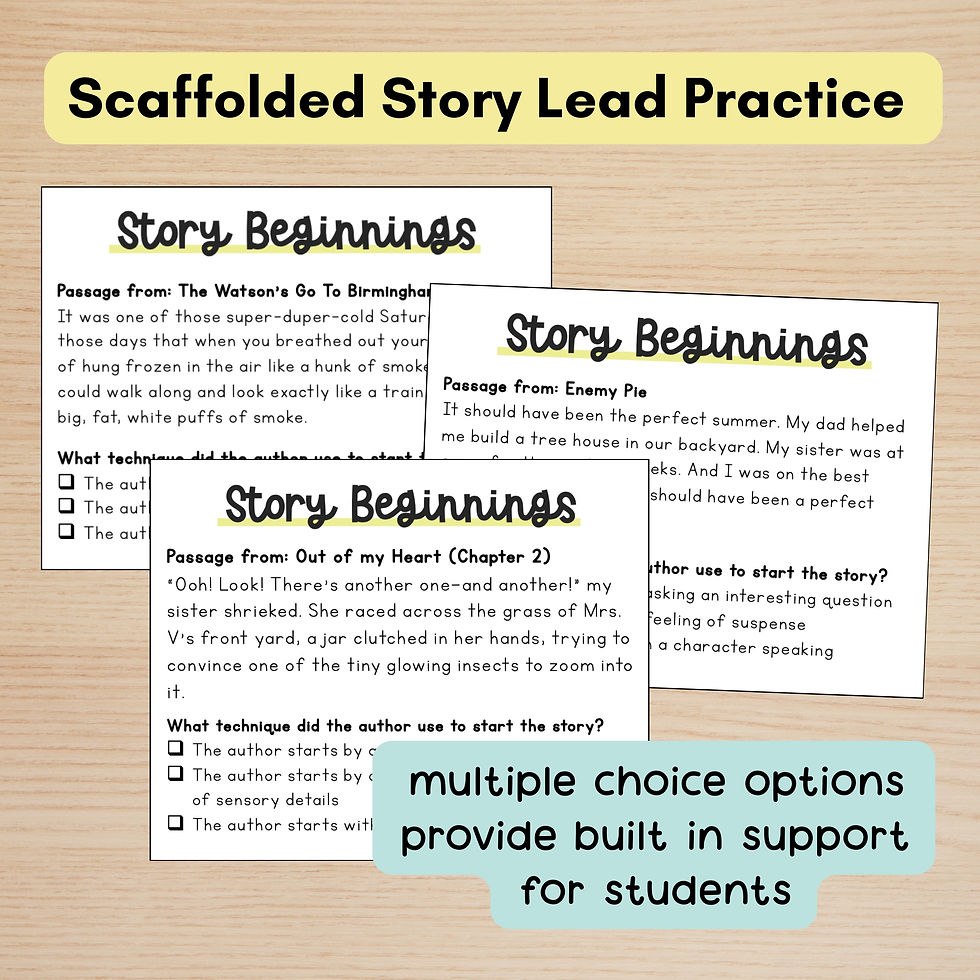
Students were introduced to several types of story leads they would see in the mentor texts and given an anchor chart for reference. For each beginning, they used guided prompts to help them identify the technique the author used.
Students on Grade Level
These students received a packet with one story lead per page. They read each one, discussed what they noticed, and jotted down observations about how the author began the story.

Students Ready for a Challenge
These students worked with packets containing multiple leads per page—all using the same technique. They read, compared examples, discussed patterns, and recorded their observations.
Extension Option:You can also turn this into a more open-ended activity using task cards. Put one story lead on each card and have students read them and group them into categories they create themselves.

Modeling and Discussion
After students worked with the mentor texts, I modeled the revision process using my own personal narrative. I rewrote my lead several times to show that crafting a strong beginning requires thought and intention—it’s not just swapping out the first sentence.
Students analyzed my versions and discussed which one they felt was the most engaging and why.
Flash Draft Reflection
Before revising their stories, students returned to their “flash draft”—a quick, initial draft written over one or two writing blocks without support. Using a reflection sheet, they considered:
What story beginnings from the mentor texts drew me in?
Is my current lead an effective way to engage readers?
What techniques am I interested in trying in my own story?

Revision
Finally, students applied what they had learned to their own stories. They didn’t just tweak a sentence—they reworked entire opening scenes, experimenting until the lead truly engaged the reader.
The transformation was pretty incredible. Stories that started flat and predictable suddenly had energy, voice, and intention. Even more importantly, students began to see themselves as authors, capabale of making thoughtful, intentioanl choices about their craft.
By teaching story beginnings this way, we give students the chance to experiment, reflect, and grow. They learn that a strong lead doesn’t just happen—it’s created through careful thought, revision, and study of authors who know their craft.
Mentor Texts List
To help get you started, I put together a list of some of the mentor texts I've found for each type of story lead.

Classroom Freebie!
click the button below to grab my Story Leads Reflection sheet and Story Leads anchor chart by clicking the button below.
I'd Love to Hear from You!
How do you help students craft strong story beginnings? Do you have any go-to mentor texts or tips for teaching leads? Share your ideas or experiences in the comments!

Comments